


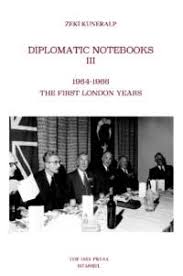
Zeki Kuneralp, Diplomatic Notebooks III, 1964–1966, The First London Years, ed. Sinan Kuneralp (The Isis Press: Istanbul, 2020); and Diplomatic Notebooks V, 1969–1972, The Second London Years, ed. Sinan Kuneralp (The Isis Press: Istanbul, 2025)
Zeki Kuneralp, a career diplomat, was a major figure in the Turkish foreign service, whose most important postings other than the UK were to Switzerland and Spain. He was also twice secretary general of the foreign ministry, one of these terms of office interleaving his two missions as ambassador in London. As with the first volume, which I reviewed on my website, these notebooks consist of meticulous personal minutes of conversations conducted in his official capacity. They are written overwhelmingly in good English but sometimes in French and occasionally in German. Rare passages in Turkish are followed by English translations. Each volume has a good index, the value of which to the researcher is enhanced by attachment of a few words of biography to the name of each individual entered in it.
Arriving in London in January 1964 – just weeks after the outbreak of serious inter-communal violence in Cyprus, the Turkish minority in serious peril, and Britain one of the three guarantors of the island’s 1960 constitution – Ambassador Kuneralp’s interlocutors were chiefly senior Foreign Office ministers and officials. However, as might be expected, they also included other heads of mission, important Turkish visitors, members of parliament (opposition as well as governing party) and journalists from leading newspapers, among others. He was much in demand. He was also much concerned to proselytise ‘the Turkish thesis’ about Cyprus: no enosis, no double enosis, no Makarios-run state in exchange for one or more Greek islands. Instead, Cyprus urgently needed to be a fully independent, confederal state – partition would be ‘even better’ (Vol. III, p. 35). Having been brought up in exile in Switzerland and fresh from running the embassy in Bern, his enthusiasm for federalism is hardly surprising. Meanwhile, the UN peacekeeping force for Cyprus created in 1964 needed to be more muscular. Failing this, he occasionally hinted, Turkey would need to exercise its right to intervene militarily, as Agha Hilaly, the Pakistani high commissioner and frequent visitor, had told him Turkey should have done in January 1964 (Vol. III, p. 19), an opinion later echoed by Duncan Sandys (Vol. V, p. 55). By the time he left London in 1966 there was no resolution to the Cyprus conflict and when he returned in 1969 it was ‘dormant but tense’ (Vol. V, p. 65); accordingly, it commanded far less of his time. He still had frequent high-level meetings with FCO officials and other heads of mission but conversations were by then focussed more on conflicts in the Middle East and South Asia, CENTO, landing rights for Turkish Airlines at Heathrow rather than Gatwick, the Queen’s visit to Turkey, prospects for tourism, and worries that his country would become politically isolated as Britain joined the EEC and Europe closed ranks.
The Notebooks are packed with interesting morsels of information. Among those that caught my eye were the opportunity provided by Churchill’s funeral in January 1965 for Turkish deputy prime minister Kemal Satır to encourage foreign secretary Michael Stewart ‘to show close interest in Cyprus’ and, incidentally, extend the time for the repayment of certain credits. Another was Kuneralp’s doomed approach to the Foreign Office a few weeks later for a gift of land for a new Turkish embassy in London on what he must have known was the lame argument that Britain had received a free site for a new embassy of its own when dragged under protest by Atatürk from the pleasures of Istanbul to the dismal environs of remote Ankara at the end of the 1920s. Others included the ambassador’s note of Queen Elizabeth’s reflection, on the occasion of his farewell audience in June 1966, that De Gaulle ‘still lives in the 18th century’ (Vol. III, p. 218); his lunch with ‘C’, Sir John Rennie, at Brooks’s on Bonfire Night 1969 (Vol. V, p. 29); his presence at two Arsenal matches as the guest of the Lord Mayor of London (although he omitted to record that the Gunners won both); and the awkward discussions between the Muslim ambassadors on the rival designs for the proposed London Mosque in Regent’s Park.
These volumes are a valuable primary source on the great range of subjects and personalities touched on, some at length, in Zeki Kuneralp’s notes. But they are also eloquent evidence of how professional diplomats who are conscientious, hard-working, popular and keep their promises can open doors of all sorts – and by such means get results for their country.